Know what you do with personal data, and be able to show it.
A processing activity is a record of one thing your product does with personal data, and why. Avaril helps you build those records from what you already have, and keeps them true as your product changes.
Processing activities
Turn every use of personal data into a structured record.
A processing activity captures one thing your organisation does with personal data, for a defined purpose. Record what data is involved, whose data it is, why it is processed, who receives it, how long it is kept, and how it is protected.
Send order confirmation emails
- Data subjects
- Customers
- Data categories
- Name, email address, order details
- Purpose
- Confirm and fulfil the customer's order
- Legal basis
- Legitimate use · s.7(a)
- Recipients
- Email delivery provider
- International transfers
- United StatesSafeguards documented
- Retention
- 30 days after order completion
- Security measures
- Encryption in transit · Access controls
DPDPA governance
Privacy Governance, Built Around Your Data
Understand what the DPDP Act expects from your organisation, starting from transparent data collection and purpose-specific consent to retention and deletion. Build a clear picture of how personal data moves through your systems, why it is processed, and when it must be deleted, turning regulatory obligations into actionable privacy governance.
Most of these duties are expected to start around May 2027, eighteen months after the Rules were notified on 13 November 2025. Sections refer to the Digital Personal Data Protection Act, 2023. Some duties have exceptions, such as retention where a law requires it and the exemptions the Rules prescribe under section 9.
Start from whatever you have
You don’t begin with a blank spreadsheet. Pick the way in that fits where you are.
No time to start from scratch
Avaril Exchange
Pick from activities Avaril has curated and add them to your record.
You already have a privacy policy
AI Extract
Uses AIUpload a policy PDF or image, or describe your product. An AI model drafts activities for you to review.
You want to be guided
Questionnaire
Answer plain-language questions, like “Does your product have a login screen?”, and get matching activities.
Your vendors send paperwork
Imports
Read a vendor’s DPA PDF (parsed by rules, no AI), or load a RoPA Passport file.
You want full control
Add manually
Fill in every field yourself.
Connected, not a spreadsheet
The record is linked to the code, data, vendors and retention it describes.
The record
Processing activity
Your code
The Python SDK lets a function name the process it implements, using the same ID as your workspace. Your workspace exports its declared processes for the SDK to read.
@avaril.process(
  id="proc_consent",
  client=client,
)
def handle_signup(request):
    ...
Data assets
The data stored for this purpose is bound to the activity.
Vendors
Who touches the data, and whether a DPA is in place.
Retention
How long the data is kept, why, and what happens at the end.
Enforce the privacy regulatory rules in your software.
Processing activities aren't just records in a workspace. Declare them in code with the SDK, then let the CLI catch the moment your software drifts from what's declared.
import avarilfrom avaril import AvarilClientfrom .services import LoginServiceclient = AvarilClient(publishable_key="av_pk_live_...")service = LoginService()@avaril.process(id="authentication_process", client=client)def handle_login(request):avaril.consent_trigger()response = service.function_login(request)avaril.retain(request.id)@avaril.process(id="authentication_signout_process",client=client)def signout(request):avaril.consent_trigger()service.function_signout(request)avaril.deletion_trigger(request.id)
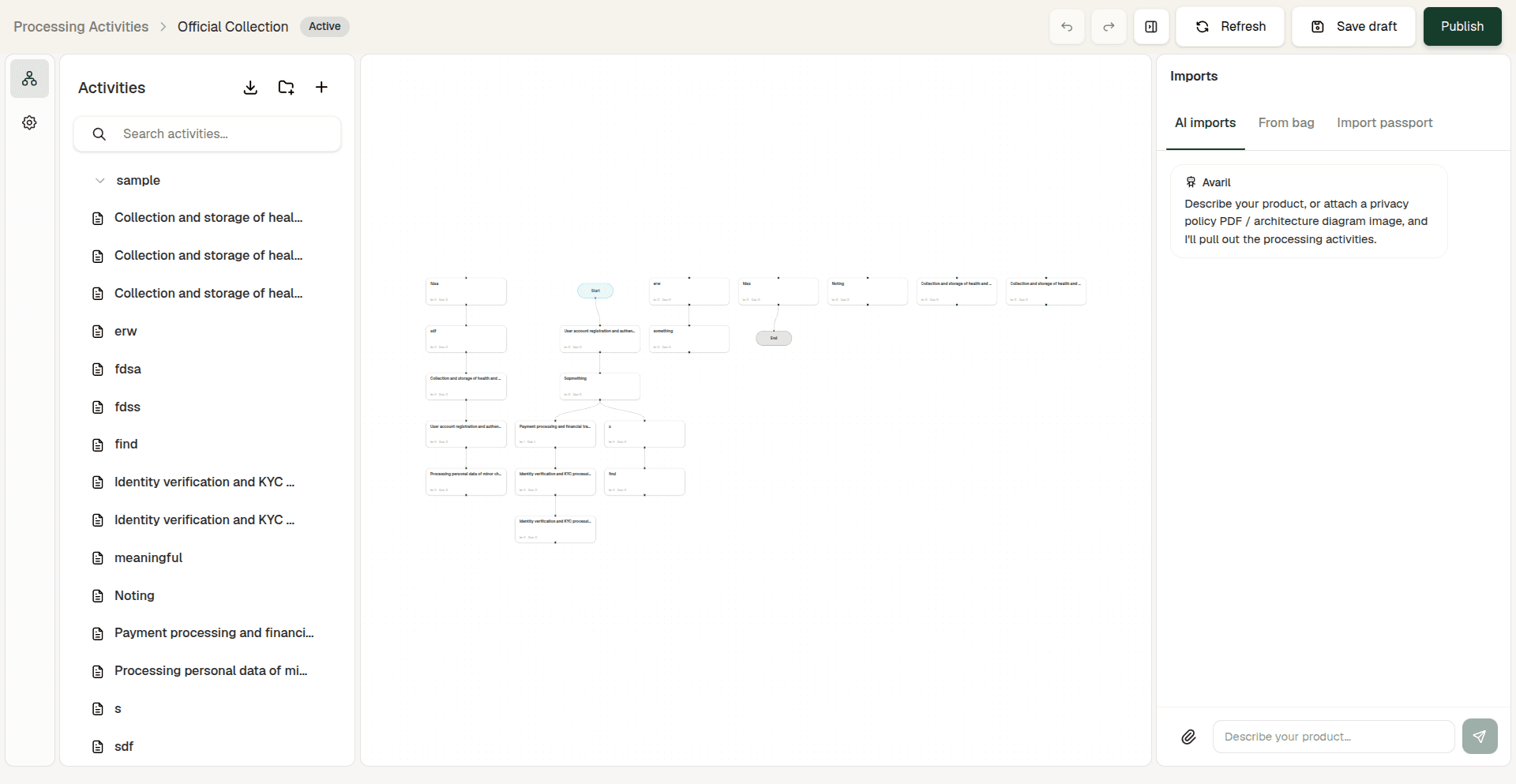
Graphical editor
A visual operating map for your processing activities.
Transform processing records into an interactive graph of actors, activities, systems, data flows, and legal bases. Avaril keeps the visual model continuously aligned with the underlying records as your processing environment evolves.
Visualize
Every activity becomes a node, connected to the actors who trigger it and the legal basis it relies on — laid out automatically, no manual diagramming.
Trace
Follow a data flow from an actor through to the lawful ground it's processed under, with a legend and minimap for workspaces with dozens of activities.
Export
Pull the diagram out for an audit, a DPIA, or a board update, without reaching for a separate diagramming tool.
Take your record with you
A RoPA Passport is one encrypted file holding a set of activities. Import it into another workspace to start from a known baseline, or hand it to an advisor.
- Encrypted with AES-256-GCM, using a passphrase you choose (12+ characters). Avaril never stores it.
- Signed with Ed25519. A passport signed by Avaril’s platform key imports as Verified; any other imports as Unverified.
- Imports open as a preview first. Nothing is written until you confirm.
- Every export is logged in your export history.
Build Privacy Governing Workflows Faster business-ready?
Built for Startups and MSMEs navigating Privacy legal compliance, privacy operations, and consent management at scale.
No spam, ever. We'll only send you product updates.